

When & (More Importantly) How to Requeen a Queenless Hive
Seeing multiple eggs inside cells and no sign of the queen is a sign of laying workers, who deem the colony “hopelessly queenless”. No worker larvae remains for raising emergency queens, and the workers continually lay unfertilized eggs, hatching into drones right until colony collapse. Management is more complicated than “just requeen it”- workers will kill your introduced queen under the assumption that Her Majesty is still here, laying drones.
Dealing with hives at the hopelessly queenless stage is done by suppressing the activated worker ovaries. An intensive method is to add brood frames every 2-3 days for a few weeks, whereas performing a newspaper combine is simpler and more reasonable. Eventually, the brood pheromones will suppress the worker’s ovaries and no more worker eggs will be laid, enabling the beekeeper to requeen, or the let colony raise their own.
How do beekeepers know when their hive is queenless, and what are the behaviours of queenless colonies? I consider this a companion article to worker policing, providing practical beekeeping advice. If you’re after the genetics and biological basis controlling laying workers, go read that article.

How to Requeen a Queenless Hive
“When” to requeen your hive is simple: the sooner the better. “How” to requeen is far less simple, dependent on the duration it’s been queenless, the current brood nest status, and the behaviour of your workers – are they laying eggs?
Requeening a Hive in the Early Stages of Queenlessness
An example of “early stage” starts when you find the queen during an inspection, attempt to mark or handle her and then… Whoops. Been there. The colony is now without a queen, and after her pheromones dissipate (~24 hours), they will begin rearing emergency queens from the available larvae.
It is up to you whether you’d like to wait ~30 days for the queen to emerge, mature and mate, or order a new queen for introduction. The former method is for the relaxed beekeepers, or those who want to preserve the colony’s genetics – if she’s a good queen, then her daughters should also be good queens. It does carry the risk of the queen mating poorly/unsuccessfully, or failing to return from her mating flight.
The latter is a fast and more-effective method of requeening, chosen by many beekeepers with $50 to spare.
If the Hive Had No Brood, Requeen Commercially or via Brood Comb Introduction
In rare cases, the queen is laying poorly, or not at all, and the workers had not superseded her. This was the case in one of my colonies, and I made the mistake of “I’ll let her, she’ll be right”. No honey was extracted that season, and In should have requeened after the second inspection. 20/20 hindsight strikes again.
If you find yourself queenless and without replacement brood and no worker-laid eggs, you could place a brood frame from a strong colony (with good genetics) and let the colony raise their own queen, or order in a queen from a commercial breeder.

Requeening a Hive When Workers are Laying Eggs
Adapted from Worker Policing
This is where the fun begins. As far as the colony is concerned, Her Majesty is still in the hive, laying drone eggs; any introduced queen will be rejected and killed. The extent of combs containing worker-laid egg determines whether you replace them with fresh frames. Freeze these removed frames, for one or two days to kill the eggs, return them to the hive and for the workers to clean. This approach is combined with one of these three options:
Take the brood box a short distance (~50-100 meter), shake the bees off the frames, and return the box to the original location. Then, add a brood frame from another hive.
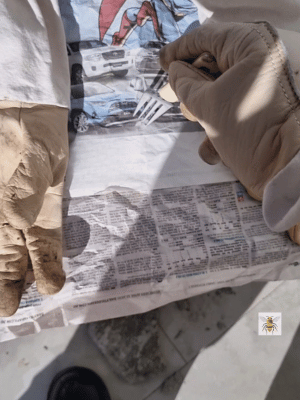
Perform a newspaper combine. The queenless colony is going to be weaker, so add them to a hive containing a laying queen. Take two pages of newspaper, poke small holes (with a toothpick) into the sheets to help bees chew through the material, and place them on top of the queened hive. Then, place the queenless hive box on top, and wait for around two weeks.
The prolonged approach suggested by a member of my beekeeping club was to to add a brood frame every few days for about a month. The logic being is that over time, the brood pheromones suppress the activation of additional worker ovaries while the old ones die out. After a month, requeen the hive with a caged queen. If you have the time and resources, go for it.
Scientists say Direct Introduction Following Queenlessness is the Most Effective Method
A 2008 paper by Perez-Sato and colleagues considered the “direct introduction with smoke” method as fastest and most successful requeening method. They compare this against other methods, like:
- Caged queen introduction,
- Letting the colony raise a new queen bee from an added brood frame,
- Smoking the hive entrance, then placing the queen on it and allowing her to walk in, and
- Continual spraying of sugar syrup onto brood frames and the new queen as she is placed in the recipient hive.
The authors used smoke to mask and wash away the current scents inside the colony. After heavy smoking, the worker bees search for the queen pheromones. Upon sensing the new queen, immediate treating her as their own, oblivious to her absence prior to smoking. I do not think this strategy works in laying worker colonies, for those workers have become false queens, and the lack of worker brood means they’ll (successfully) overwhelm the introduced queen.
As their headline states, when bees have been queenless for two days, smoking the hive prior to direct introduction (i.e. releasing the queen onto frames) was almost always successful. During their other attempts, workers rejected the new queens by heat-balling them to death, a response more frequently observed towards virgin queens.
Workers are less aggressive to queens as the time spent queenlessness increases, up to a point. I suggest that this is due to a reduced level of queen pheromones, but not to such low levels that the colony begins sounding her absence or activating their ovaries. Perhaps two days is the sweet spot for immediate queen acceptance?
When to Inspect After Requeening
A question raised by reader Peggy was around reinspecting hives after requeening. My answer: after two weeks, minimum. The hardest part of beekeeping is letting the bees be- to settle in and adapt to their new environment. A caged mated queen will lay eggs 2-3 days after her release, also calming the workers in the process (Kanelis et al., 2023). Despite this, data from Kanelis and colleagues suggest that 9-10 days post introduction is a better timeframe, as that is when the colony resumes their typical vibrations patterns. You also don’t want to stress the new queen as she learns to lay eggs in her new home.
If the queen settles successfully, you’ll see capped brood and larvae in varies stages. At this stage, you can begin to mark the queen (if you haven’t already done so) and conduct Varroa testing or apply treatment as necessary. Thank you for asking Peggy, and remember, two weeks!

Queenless or Honeylocked Hives?
The contents of the brood nest differentiate a queenless hive from a honeylocked one. In honeylocked hives, you’ll find the majority of frames contain capped honey, with a restricted brood pattern towards the bottom-center of the frame. If there is pollen instead of capped worker brood, then the colony could still be rearing larvae. Honeylocked hives can be resolved by giving bees more space – add a super and/or replace the honey frames with fresh ones.
By contrast, there is a lack of brood and pollen in queenless hives and a larger number of honey comb; space is not the issue. In one queenless hive, I found no eggs, a low worker population, and every frame filled with nectar for honey production. Another sign was their sudden aggression towards my presence in the backyard, followed by bee sting complaints from the neighbours. Oh dear.
Further, honeylocked hives are not relatively gentle. Queenless hives will chase you aggressively, yet not quite as aggressively as their Africanised cousins.

Fewer Workers, More Drones: Signs of Laying Workers
The foremost sign of a laying worker is the number of eggs per cell. Lots and lots of uncentered eggs. Worker abdomens are shorter than queens’ and cannot reach the bottom of the cell. Under normal conditions, these eggs are removed (“policed”) by other workers and the beekeeper does not see them. If the eggs were to develop, the larvae will become drones, as worker-laid eggs are unfertilized, except in Cape honey bees.
With the continual emergence of drones and no workers, the colony slowly loses strength, becoming more prone to robbing by other bees, diseases or predation. When a queen lays multiple eggs per cell, the workers will move the excess eggs into an empty cell and to develop as normal1.
Anomaly: Continual Worker Policing in a Queenless hives
Chaline and colleagues report that despite being hopelessly queenless, one colony continued to remove worker-laid eggs (Chaline et al., 2004). Originally, the authors suggested that the workers were not laying eggs, and after examination, found that most “naturally-laid” worker eggs were removed within an hour, and all eggs were removed within 20 hours. They suggest that a rare genetic mutation caused this colony to maintain policing behaviour in the absence of a queen, rather than switching it off.
Further, when queen-laid eggs were introduced, they were also removed by this colony, but at a lower rate. The authors suggest that the hive knew it was hopelessly queenless, and did not expect to encounter fertilized eggs, leading to immediate removal via consumption (Page & Erickson, 1988).

The Signs of Queenlessness Change Over Time
Queenlessness is not one fixed condition. Below is a timeline of the colony’s response to losing their queen:
- Immediate response (0-24 hours): Outwardly, the colony appears normal, but workers are sensing the queen’s pheromones, leading to increasing worker agitation, producing vibrations to signal their distress within the colony.
- Emergency response (1-3 days): Workers begin preparations for emergency queen rearing if young larvae are present. They start forming the queen cell cup around their chosen larva(e).
- This is when you’d see scattered queen cells on the brood frame.
- Worker ovary activation (2-7 days): If an emergency queen cell cannot be formed, some worker bees will activate their ovaries and begin laying unfertilized eggs (Martin et al., 2004).
- Hopelessly queenless state (7+ days): If a new queen has not been successfully reared or introduced, the colony becomes hopelessly queenless. Worker egg laying continues, and colony cohesion breaks down. Odds are the bees start becoming increasingly aggressive.
- Colony decline & collapse (weeks to months): Without a laying queen to maintain reproductive and social cohesion, the colony’s population begins to decline and eventually collapse.
- The colony becomes prone to robbers, pests and diseases.

Why are Queenless Hives Aggressive?
Sakagmi’s 1954 paper suggests three factors for aggressiveness in queenless hives:
- Physiological changes in other workers (activated worker ovaries).
- The ability of a worker bee to sense the active ovaries of her nestmates.
- The degree of aggressiveness between the worker with an active ovary, and the one doing the aggression.
He likens this to a dominance/pecking order hierarchy as seen in the social Polistes (paper wasps). The queen normally keeps all her workers sterile and reproductively equal. In a queenless honey bee colony, worker ovary development enter into a competition with their sisters for egg-laying dominance. This produces a domino effect: more workers’ ovaries activate, and more “false queens” emerge, right until colony collapse.
This seems to be the case, as later work showed that a mix of reproductive competition and changes in pheromone production (from queen pheromones to a worker/false queen pheromones) resulted in aggression. Workers compete with another to reproduce and pass on their genes. The resulting hostility is projected onto the beekeeper and surrounds. These bees sting indiscriminately and unprovoked in order to protect the nest (Blom 1991; Malka et al., 2008).
The Queenless Roar Begins as a Warble
Using microphones, Rex Boys characterised the sound of bee hives on the basis of swarming observations (Boys, 1999). He states that 14 days prior to queen cell production, the workers produce a “warbling” sound (think of it as a “high trill”: “rrrrrrrrrrrrr”). This sound peaks when an egg is placed into the queen cup, and slowly declines, disappearing a few days prior to the swarm’s departure.
The author suggests that warbling is a sign of decreased queen performance (egg laying) in preparation for swarming (decreasing bodyweight via reduced feeding & increased movement). When the queen is absent altogether, the warble is replaced with a lower-pitched “moan”. In extended periods of queenlessness, the moan develops into the well-known “queenless roar”, followed by aggression. This roar is produced by excessive fanning by the bees, perhaps in an attempt to spread the Nasonov pheromone and help guide their lost queen back to the hive.
Acoustic Testing for Colony Health
Listening to the bees is nothing new, and experiments there have been experiments on this for decades – in Boys’ 1999 book, he cites experiments from the 1960’s and prior. Colony vibrations have been studied as a way to predict swarming, queenlessness, disease states and queen presence, you name it. With advances in machine learning & AI, interest in the field has taken on a new interest, enabling researchers to compare the results from one hive against a benchmark to determine colony status.
This non-invasive approach is considered simple and low-cost compared to suiting up for an inspection. Further developments can provide data on hives’ colony health, colony strength, swarming, responses to weather, pest infestation, diseases and pesticide exposure. The interested reader is referred to Kanelis et al., (2023) & Rustam et al., (2023).

Fix Queenless Hives with Requeening
There are multiple signs and causes of queenlessness. Did she die? Did she mate poorly? Or are bees running out of room to store their honey? The ultimate fix to queenlessness is to requeen your hive. How you requeen is dependent on the duration of queenlessness.
A direct introduction may not work when the hive’s workers lay eggs– you’ll need to slowly add brood or combine it with another hive. If you’ve (accidentally) crushed Her Majesty in your last inspection, then either get on the phone for an express mated queen delivery, or let the hive raise a new queen from the remaining fertilized worker bee eggs. For backyard beekeepers, requeen quickly- you don’t want your bees to become aggressive and sting the neighbours – my tardiness costed me an apiary.
Read the whole post and found puns, typos mistakes? Voice your displeasure with a strongly-worded message to admin@tgbee.com.au, or by filling this form.
Footnotes
- *I once had workers move a dozen queen-laid eggs into the super, resulting in a very concerning inspection – how did Her Majesty get past the excluder? In the end, that worker brood emerged and the cells were refilled with honey… You can never tell with bees! ↩︎